How Much Protein Do You Need Per Day?
From the healthy minimum to the muscle-building range, with a simple table by body weight.
Direct answer
For general health, Australian guidance lists about 52 to 64 g of protein a day for adult men and 37 to 46 g for women. If you lift weights to build muscle, research suggests about 1.6 g per kilogram of body weight per day, which is 120 g for a 75 kg person, with little extra benefit above that on average.
Key takeaways
- Australian guidance lists about 52 to 64 g a day for adult men and 37 to 46 g for women for general health.
- For muscle building with resistance training, gains plateaued at around 1.6 g/kg/day on average.
- Older adults are advised at least 1.0 to 1.2 g/kg/day.
- Spreading protein across at least four meals of about 0.4 g/kg each is a practical approach.
- People with kidney disease should follow medical advice on protein intake.
Protein advice ranges from "most people eat plenty" to "a gram per pound or you will lose your gains". Both can be true, because they answer different questions. One is the minimum to stay healthy; the other is what helps you build muscle when you train. Here is what Australian guidance and the research say, how to calculate your number, and how to hit it without overthinking.
How much protein do you need per day?
It depends on your goal:
- For general health: healthdirect lists daily protein needs for adults aged 19 to 70 of about 52 to 64 g for men and 37 to 46 g for women, rising to about 65 to 81 g for men and 46 to 57 g for women over 70. It also notes that 10% to 35% of daily energy can come from protein.
- For building muscle with resistance training: a 2018 meta-analysis of 49 trials with 1,863 participants found that extra protein increased gains in strength and muscle during resistance training, but intakes above about 1.6 g per kilogram of body weight per day produced no further gains in fat-free mass on average (Morton et al., British Journal of Sports Medicine, 2018). The International Society of Sports Nutrition suggests 1.4 to 2.0 g/kg/day for most exercising people (Jäger et al., 2017).
- For older adults: an expert group recommended at least 1.0 to 1.2 g/kg/day for healthy older people, and more for those who are active or unwell (Bauer et al., PROT-AGE Study Group, 2013).
How much protein is that for my weight?
| Body weight | 1.0 g/kg (older adult minimum) | 1.6 g/kg (muscle-building average) | 2.2 g/kg (upper end used in research) |
|---|---|---|---|
| 55 kg | 55 g | 88 g | 121 g |
| 65 kg | 65 g | 104 g | 143 g |
| 75 kg | 75 g | 120 g | 165 g |
| 85 kg | 85 g | 136 g | 187 g |
| 95 kg | 95 g | 152 g | 209 g |
These figures are simple arithmetic (body weight multiplied by the target). The 1.6 g/kg figure is an average; the Morton meta-analysis's confidence interval suggests some people may benefit from up to about 2.2 g/kg. If you carry a lot of body fat, many dietitians base targets on goal or lean body weight instead.
How do you work out your protein target, step by step?
- Pick your goal. General health, building muscle, or maintaining muscle while losing fat.
- Choose a multiplier. Around 1.6 g/kg is a sensible default for people who lift. Use the healthdirect amounts as your minimum if you do not train.
- Multiply by your body weight in kilograms.
- Divide across your meals. A 2018 review suggested about 0.4 g/kg per meal across at least four meals to reach 1.6 g/kg/day (Schoenfeld and Aragon, 2018). For a 75 kg person, that is about 30 g per meal.
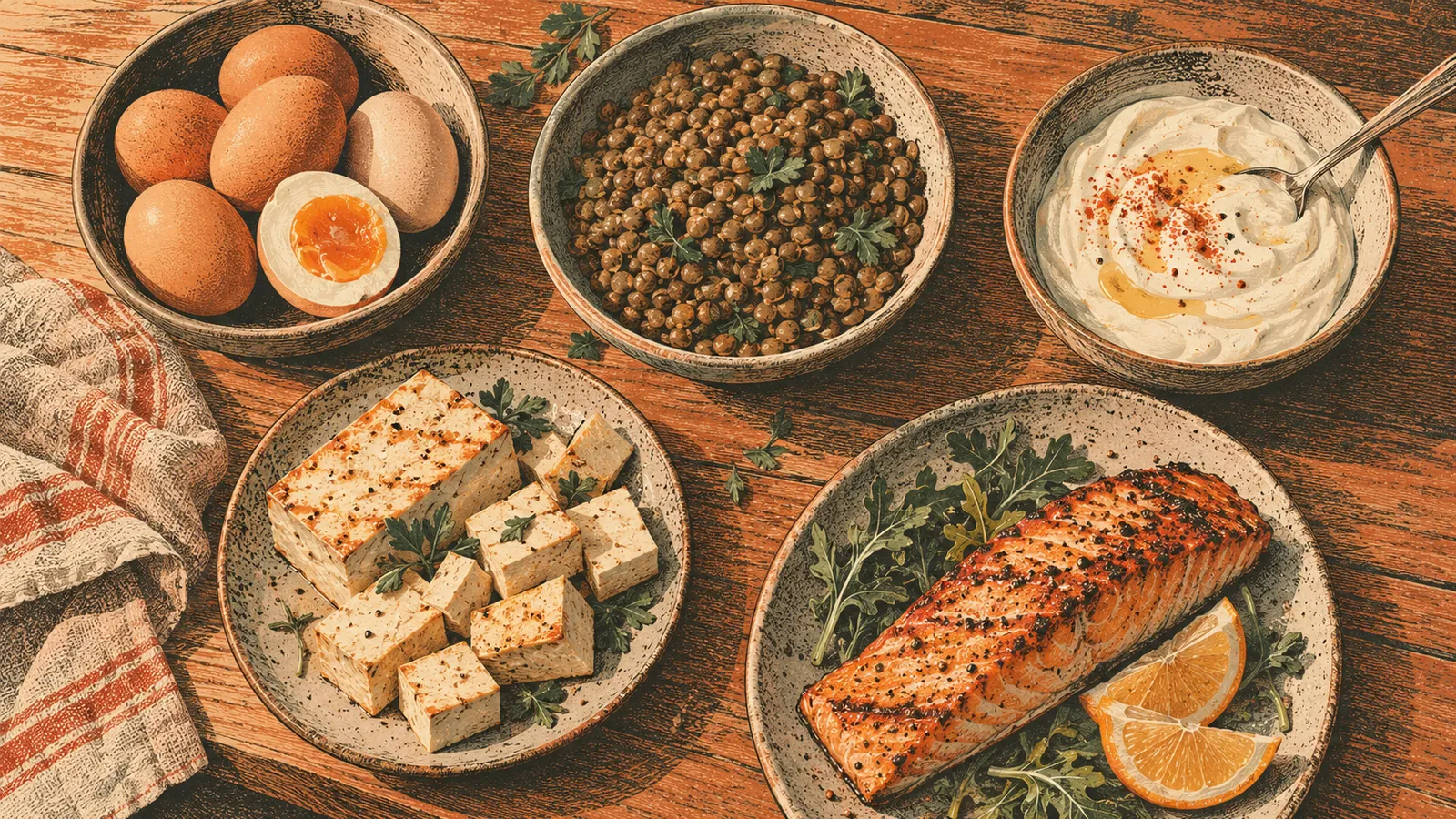
- Build meals around a protein source. Meat, fish, eggs, dairy, tofu, tempeh, legumes or a protein supplement.
- Track for a week or two. Most people misjudge their intake. A short tracking period shows where you actually are.
- Adjust by results. If your training is progressing and you recover well, you are likely in a good range.
Do you need more protein when losing fat?
Higher protein intakes are commonly recommended during fat loss to help preserve muscle and manage hunger. The ISSN position stand discusses higher intakes in a calorie deficit for resistance-trained people. Keep strength training in place too; protein alone does not preserve muscle without the training stimulus. See how often beginners should lift.
Is eating a lot of protein harmful?
For healthy adults, intakes within the ranges used in sports research are generally considered safe in the ISSN position stand. People with kidney disease are different and should follow their doctor or dietitian's advice on protein. If you have any medical condition, are pregnant or have a history of disordered eating, get personalised advice. This is general information, not medical or dietary advice.
What are the best protein sources?
Both animal and plant proteins work. A good diet usually mixes several sources: lean meat, poultry, fish, eggs, dairy, legumes, tofu, tempeh, nuts and seeds, as healthdirect lists. For plant-based eaters, soy is one of the most complete plant proteins, and research comparing it with whey is covered in soy protein vs whey for muscle.
What are the common protein mistakes?
- Back-loading protein into dinner. Spreading it across meals makes the daily target easier and may help muscle building; see how much protein your body can use per meal.
- Chasing extreme intakes. Above about 1.6 g/kg, extra protein added little on average in the research.
- Relying on supplements. Powders are convenient, not required. Whole foods bring other nutrients.
- Guessing. Most people overestimate. Track briefly to get a real baseline.
What is the easiest way to track protein?
A food diary or a nutrition app for a week or two is usually enough to learn which meals carry your protein. If you want something faster than manual logging, MyMacro, an AI nutrition app that is coming soon, is designed to make macro and protein tracking quicker; you can join the waitlist (MyMacro is TodayForge's sister business). Whatever method you use, the goal is to learn your patterns, not to track forever.
General information, not medical advice. Talk to your doctor, dietitian or another qualified health professional before changing your training, diet, sleep or supplements, especially if you have a medical condition or take medication.
References
- Protein (healthdirect Australia)healthdirect.gov.au
- A systematic review, meta-analysis and meta-regression of the effect of protein supplementation on resistance training-induced gains (Morton et al., British Journal of Sports Medicine, 2018)pubmed.ncbi.nlm.nih.gov
- International Society of Sports Nutrition position stand: protein and exercise (Jäger et al., 2017)pubmed.ncbi.nlm.nih.gov
- Evidence-based recommendations for optimal dietary protein intake in older people: PROT-AGE Study Group (Bauer et al., 2013)pubmed.ncbi.nlm.nih.gov
- How much protein can the body use in a single meal for muscle-building? (Schoenfeld and Aragon, Journal of the International Society of Sports Nutrition, 2018)pubmed.ncbi.nlm.nih.gov
FAQ
Is 1 gram of protein per pound too much?
One gram per pound is about 2.2 g/kg, the upper end used in research. It is generally safe for healthy people, but the average benefit for muscle levelled off around 1.6 g/kg.
Does protein need to be eaten right after training?
Total daily protein matters most. Having a protein-rich meal within a few hours of training is a sensible habit rather than a strict window.
Can you build muscle on a plant-based diet?
Yes. Research comparing high-protein plant-based and mixed diets found similar strength and muscle gains when protein intake was matched.
How much protein is in common foods?
Check nutrition labels or a food database. Meat, fish, eggs, dairy, tofu, tempeh and legumes are the main sources.
Do women need less protein than men?
Needs are based mainly on body weight and activity. Per kilogram, training targets are similar for men and women.